The Thinking Statues of Safety
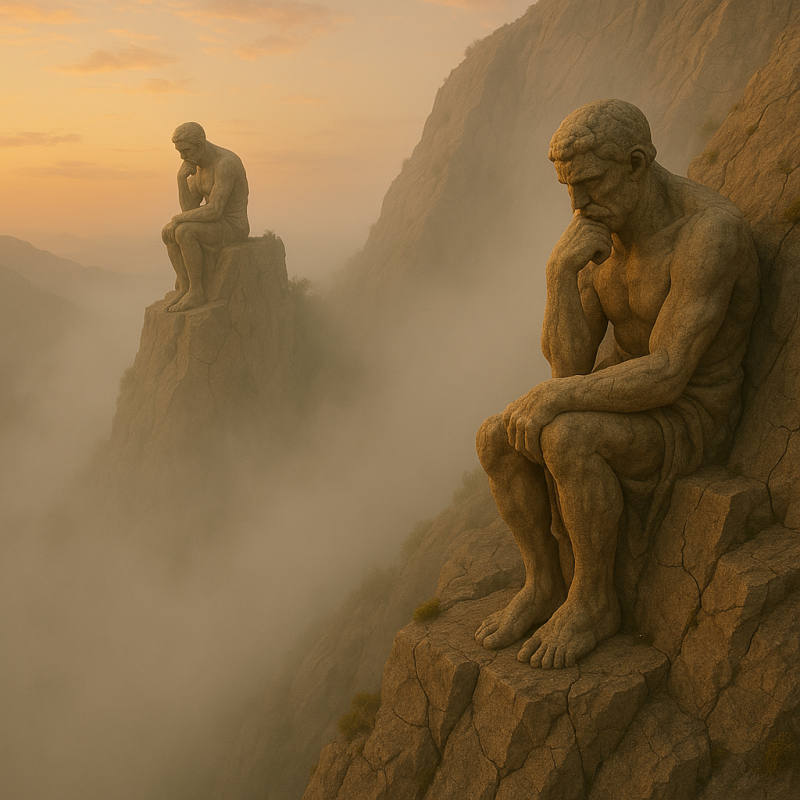
Sociologist Norbert Elias’s parable of the thinking statues offers a very nice way to understand why safety work so often fragments into competing explanations. In the story, each statue stands fixed on the mountainside. Each can see something happening across the valley. Each forms judgements and interpretations. But none can move toward what they observe, and none can see what the other statues see. They are thoughtful, but immobile, and certain, yet unable to verify their certainty. I use this image to describe what so often happens in safety practice.
Each statue sees one slice of reality
In safety management, different roles and disciplines all view accidents through their own lenses. People see choices, or design, or culture, or complexity, or leadership, or uncertainty, depending on where they stand. Each perspective reveals something true. Each also hides something else. Each viewpoint is shaped by its position, its training, its language, its professional identity, and its history.
From the statue’s viewpoint, its interpretation feels complete. It sees a coherent picture. Its ideas make sense. What we notice, what we treat as meaningful, and what we diagnose as causal all feel obvious from where we stand. But our explanations are never just technical observations. They are products of our social formation, our roles, and the traditions we’ve inherited. We think we are describing the world, but more often, we are describing our relationship to it.
Thinking harder from the same place doesn’t change the view
A statue can reflect endlessly, but it can’t move. The view remains the same. Safety management often repeats this pattern. It applies more effort, more analysis, or more controls from within a single perspective; only to find diminishing returns. The issue is not a lack of intelligence or effort, but the position taken. We remain anchored to the same assumptions, asking the same kinds of questions, and seeing the same kinds of causes. We refine the perspective, but we rarely change it.
The unbridgeable gap appears only when we stay statues
The statues believe the distance between their ideas and reality can’t be crossed. Not because it is truly impossible, but because they can’t move. Safety debates often feel the same way. Different viewpoints stand apart, looking at the same landscape from different angles, each convinced of its own clarity, each believing others simply don’t understand.
The gap between perspectives feels fundamental, but Elias’s point is that we are not statues:
- We can walk toward one another’s views.
- We can place our interpretations side by side.
- We can test, compare, and integrate what each of us sees.
Movement is possible. Dialogue is possible. Collective understanding is possible, if we stop behaving as if we are carved in stone.
Experience deepens a single view, while education enables movement between views
Drew Rae has written that though experience teaches us how to act within a particular vantage point, it can’t, on its own, help us see what lies outside that view. Formal and informal education is what lets us change position, to understand where our perspectives come from, to recognise other legitimate ways of seeing, to understand how multiple interpretations can coexist, and to move between standpoints rather than defend one. Experience gives depth, and education gives mobility. Both are required in safety management.
Understanding is never a purely private act
We think with concepts influenced by our society. We make sense of the world together instead of alone. Behind every individual perception lies a social history. Behind every ‘I’ stands a ‘we’.
Now, where in your work or life do you still feel like one of the statues, observing from afar, unable to bridge the gap? And what becomes possible when you recognise that the gap is not, in fact, unbridgeable?
Sources
Elias, N. (1991), The Society of Individuals, New York/London: Continuum.
Rae, D. (2019), Accident Causation Bingo, Accident Causation Bingo | LinkedIn