Sorting Things Out
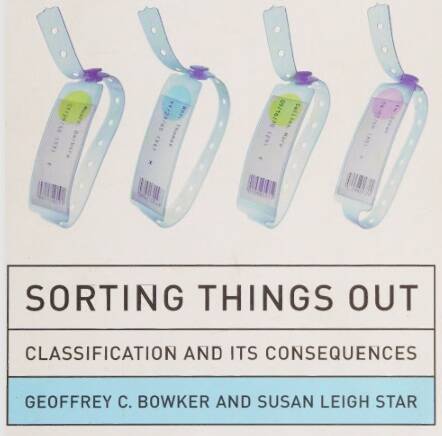
Every organisation depends on classifications. Healthcare, finance, government, HR, all create categories to make complex realities manageable. But classifications influence what we measure and how we act. Geoffrey Bowker and Susan Leigh Star make this point in Sorting Things Out:
Every classification system makes some things visible while making others invisible.
Take incident reporting. An incident reporting framework decides what counts as an incident. For example, a single event in a hospital is translated into predefined categories such as Medication, Clinical Records, Exposure, Patient Falls, Security, IT, Moving & Handling, Resource Issues. Within each category are increasingly detailed subcategories, from wrong dose and incorrect patient to delay in diagnosis, lost records, or breach of confidentiality. This structure enables hospitals to identify trends, allocate resources, improve safety, and compare performance across organizations.
But importantly, the classification also becomes the lens through which the organisation understands itself. What doesn't fit neatly into the taxonomy often becomes difficult to analyse or improve. Bowker and Star call torque what happens when people must adapt their experiences to fit administrative categories instead of systems adapting to human complexity. For example:
• Patients whose symptoms don't match diagnostic codes;
• Employees trying to fit predefined competency frameworks;
• AI systems that require human behaviour to be reduced to labels;
• Incident investigators deciding whether an event belongs under Medication, Clinical Other, or Resource Issues, even when the real situation spans all three.
Without standards there is no interoperability or learning at scale. But every standard involves choices; for instance, consistency vs nuance, efficiency vs flexibility, comparability vs individuality, visibility vs oversimplification.
Good classifications make conscious decisions about how to manage complexity. As organisations increasingly rely on data, automation, and AI, designing classifications is a design and governance challenge, and an ethical one at that. The categories we create today influence the decisions we make tomorrow.
Bowker, G.C, Star, S.L. (2000), Sorting Things Out: Classification and Its Consequences, Cambridge MA/London: The MIT Press.